

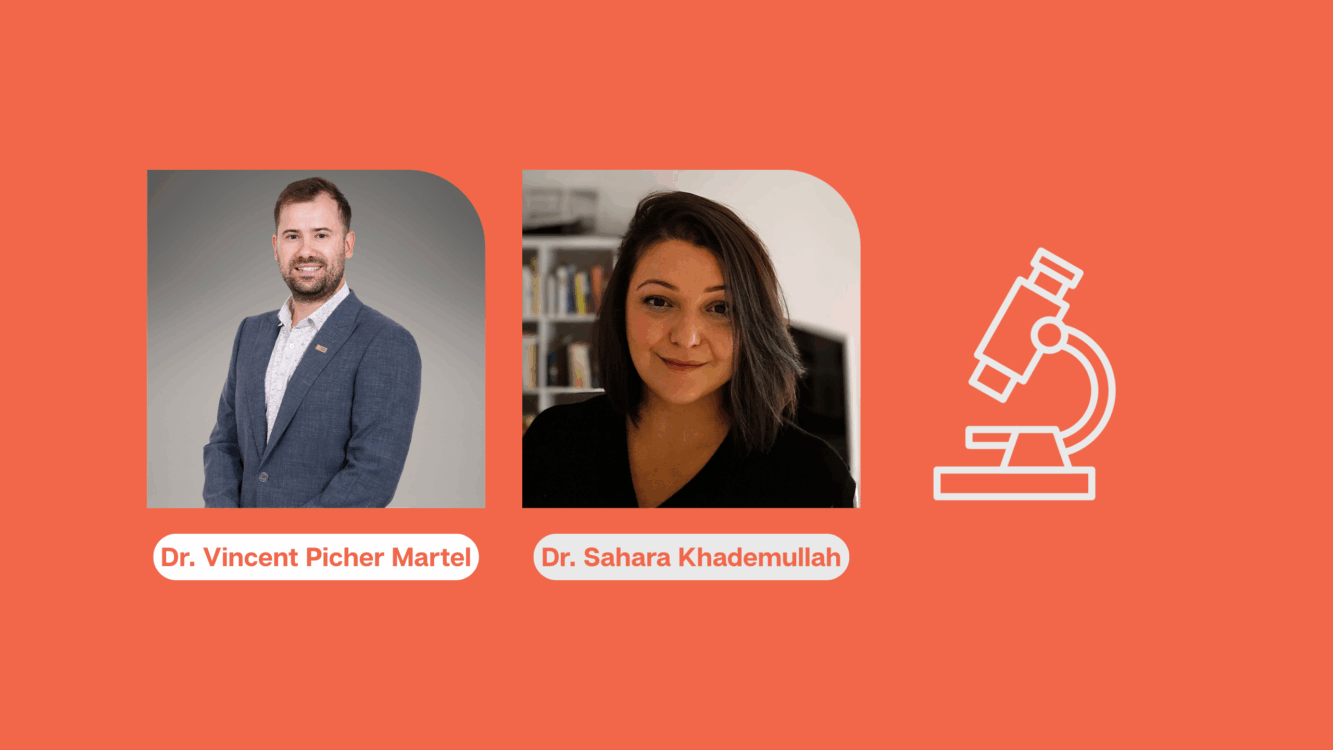
They work in different labs, study different questions, and use different tools. But Dr. Sahara Khademullah and Dr. Vincent Picher Martel have one thing in common: a deep belief in the power of scientific discovery to improve life for people living with amyotrophic lateral sclerosis (ALS), a neurodegenerative disease that is still incurable.
As early career researchers, they’re pursuing bold ideas with a deep commitment to understanding ALS and making meaningful progress. And thanks to the generosity of donors like you, they’ve recently received startup grants from ALS Quebec.
Read on to hear directly from these two inspiring people whose meaningful contributions make them voices of hope for the ALS community.
Meet the researchers behind breakthroughs in ALS: two voices of hope

- Assistant Professor, Université Laval
- CERVO Brain Research Centre
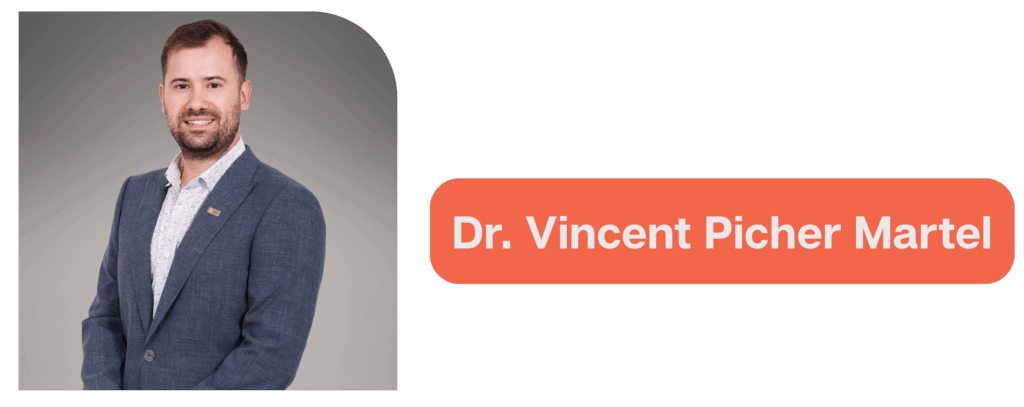
- Neurologist specializing in neuromuscular diseases (CSCN EMG)
- Assistant Professor (grant-funded), Faculty of Medicine, Université Laval
- Clinician Researcher, Department of Medicine, Neuroscience Axis
- CHU de Québec Research Center (CRCHU) – Université Laval
What inspired you to dedicate your career to ALS research?
Sahara : Watching my husband and his family navigate the painful experience of caring for their grandmother after her ALS diagnosis has strengthened my resolve to help understand this disease. I believe that as a research community, we have a responsibility to work as quickly and tirelessly as possible to ultimately change the trajectory of ALS.
Vincent : During my early training at Laval University, I took a course that made me appreciate the scientific beauty of neuronal biology and the profound consequences when these systems fail. It changed the trajectory of my career and exposed me to the immense human burden of ALS.
Today, what drives me is the unique perspective I gain as both a clinician and a researcher. I meet patients and families every week, witness their urgency and resilience, and carry that into the lab. Every experiment and every discovery is grounded in the faces and stories of the people I care for.
Why supporting early-career ALS researchers with ALS Quebec start-up grants matters?
Sahara :This funding allows us to pursue bold scientific ideas, build the foundations of a long-term research program, and access mentorship from senior members of the ALS research community. Importantly, it also creates opportunities for fundamental researchers to meet and learn from people living with amyotrophic lateral sclerosis and their families.
Vincent : Early-career grants are transformative. They empower the next generation of ALS scientists to take risks, pursue innovative directions, and accelerate progress in ways that would not be possible otherwise. Investment in early-career researchers is truly an investment in the future of ALS research.
How funding you received from ALS Quebec start-Up grants change what’s possible for ALS research breakthroughs?
Sahara : Applying to both private and public funding agencies can be challenging and time-consuming. The start-up grant from ALS Quebec made it possible for me to begin my research program immediately, without having to wait for other funding decisions. This support allows my work to move forward without interruption, accelerating the progress we can make toward understanding and ultimately treating ALS.
Vincent : The ALS Quebec start-up grant has been pivotal in transforming my lab from a conceptual vision into an active research program. This grant gives us the foundation needed to pursue high-impact discoveries that move the entire field forward.
How do you see yourself contributing to hope for the ALS community?
Sahara : For me, being a “voice of hope” means contributing research that moves us closer to meaningful breakthroughs for people living with ALS. I hope that my work, whether it leads to an early biomarker, new therapeutic avenues, or fundamental insights that other researchers can build upon, will play even a small role in shifting what’s possible for this disease.
I also believe that hope grows when our community works together. In that sense, I see my scientific efforts as one voice among many, each contributing to a unified hope for patients, families, and caregivers.
Vincent : Being both a clinician and a scientist allows me to accelerate promising findings from the lab toward clinical testing. And by sharing progress through talks, webinars, and publications, I ensure that patients see that meaningful advances are happening. Each new discovery, each paper, each target identified is a tangible step toward treatments – and that forward momentum is a powerful source of hope.
Give Now to Fuel ALS Support, Resources, and Research.